Introduction: The Material Decision That Defines Your Margins
For wholesale buyers, OEM/ODM partners, and distributors, one choice drives profitability more than any other: material selection. H59 brass and 304 stainless steel dominate the faucet market, but each serves different market segments and profit models. This guide cuts through the complexity to help you maximize margins while minimizing risk.
The cost comparisons below reflect typical market conditions. Commodity prices fluctuate significantly based on global markets—verify current pricing before volume commitments.
Part 1: Material Fundamentals
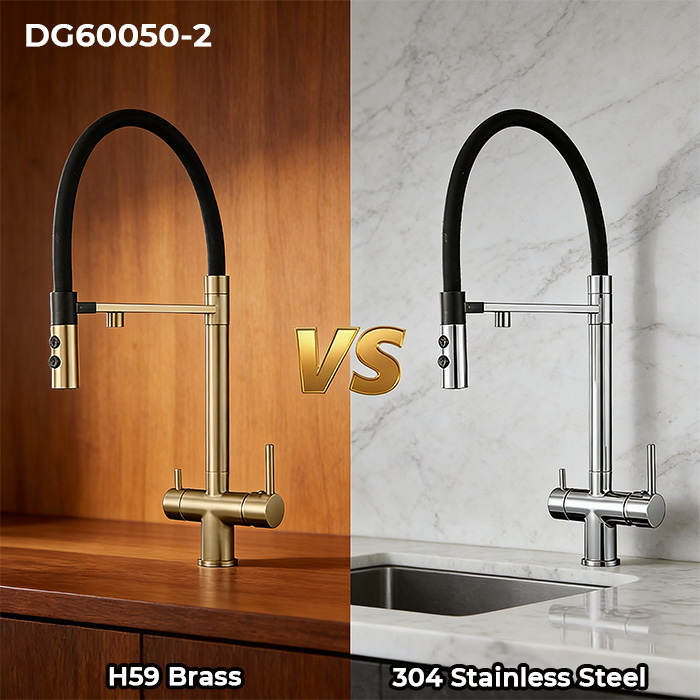
H59 Brass: The Industry Workhorse
H59 brass (CuZn39Pb3) contains approximately 59% copper, 39% zinc, and lead content below 1%. This alloy offers exceptional casting properties, plating adhesion, and structural integrity.
Key Advantages:
- Superior casting: Creates seamless monolithic structures without welded joints
- Excellent plating foundation: Strong chemical bonds with PVD coating and chrome plating
- Heavyweight premium feel: Density conveys quality to consumers
- Industry certifications: Meets cUPC, CE, NSF 61/372, and 4MS standards for lead-free brass
304 Stainless Steel: The Modern Alternative
304 stainless steel (18/8) contains 18% chromium and 8% nickel, offering corrosion resistance through its passive chromium oxide layer. Gaining traction in kitchen faucet applications where perceived health benefits drive demand.
Key Considerations:
- Welded construction: Fabricated from tubular components with multiple welded joints
- Harder machining: Increases production costs through tool wear and energy consumption
- Limited design flexibility: Constrains complex geometries and ornate designs
- Higher finished product costs: Despite lower raw material prices, stainless steel faucets typically cost more due to processing complexity
Part 2: Durability and Corrosion Resistance
Brass Performance in Real-World Conditions
Brass faucets excel in bathroom applications where humidity, temperature fluctuations, and constant water exposure create harsh conditions. The non-ferrous nature eliminates iron-based rust, while modern electroplating provides exceptional protection.
Durability Testing Results:
- Salt spray resistance: 96+ hours in ASTM B117 testing without corrosion
- Cycle testing: 500,000+ operation cycles
- Temperature tolerance: Reliable performance from -20°C to 90°C
- Pressure resistance: Handles 0.1-0.8 MPa operating pressures
The casting process eliminates seam lines, creating homogeneous structures ideal for shower mixers and bathtub faucets where failure behind walls creates expensive repairs.
Stainless Steel Durability Characteristics
304 stainless steel relies on its chromium oxide passive layer for protection, performing well in most residential environments:
Performance Characteristics:
- Good corrosion resistance: Performs excellently in typical household conditions
- Chloride sensitivity: May experience pitting in extreme marine environments (316 preferred for coastal applications)
- Surface durability: Hard surface resists scratches and wear
- Chemical resistance: Excellent against cleaning chemicals and food acids
For kitchen sink faucets, stainless steel's chemical inertness and easy cleaning become significant advantages.
Part 3: Surface Finishing and Aesthetics
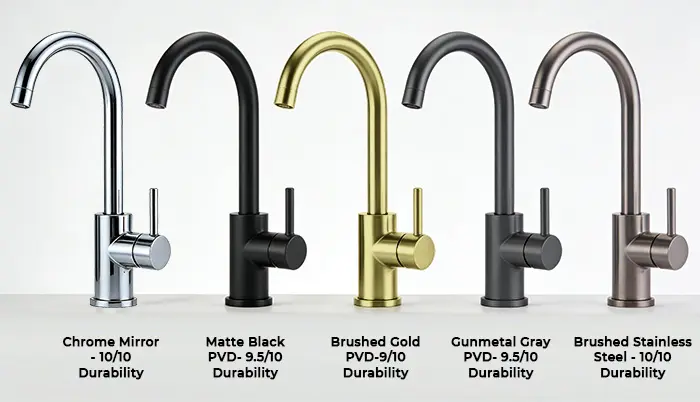
Brass as the Superior Foundation
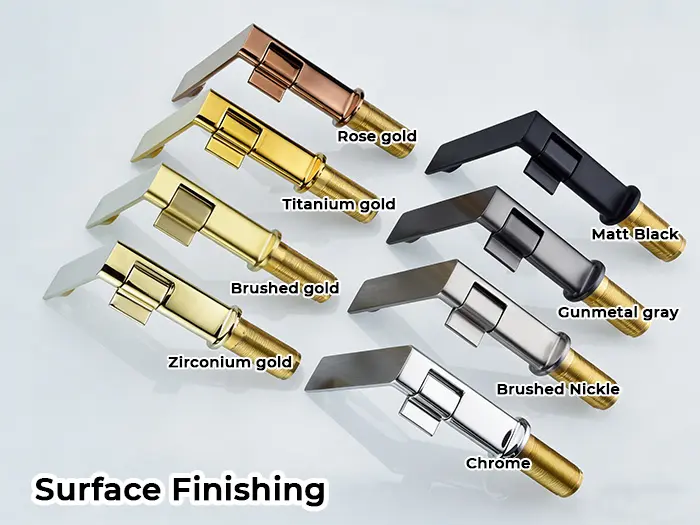
The copper-rich surface provides an ideal substrate for surface finishing technologies, enabling diverse aesthetic options that command premium pricing:
PVD Coating (Physical Vapor Deposition):
- Creates molecular-bonded coatings 10 times more durable than traditional electroplating
- Enables matte black, brushed gold, gunmetal, rose gold, and other high-demand finishes
- Withstands 50,000+ scrub cycles without wear
- Resists scratching, tarnishing, and UV degradation
Chrome Plating:
- Industry standard for durability and ease of cleaning
- Provides mirror-like brilliance valued in traditional markets
The chemical affinity between brass and plating materials creates superior adhesion, preventing peeling issues common with plated steel alternatives.
Stainless Steel Aesthetic Options
304 stainless steel faucets traditionally feature brushed finishes that provide modern, minimalist aesthetics:
Finish Options:
- Brushed stainless steel: Standard, durable, easy to clean
- PVD coating: Available at premium price points for color variations
- Electropolishing: Creates smooth, sanitary surfaces
The constrained aesthetic palette positions stainless steel effectively in modern or industrial design contexts, while brass spans traditional, transitional, and contemporary styles.
Part 4: Cost and Profitability Analysis
Material Cost Comparison
| Cost Component | H59 Brass | 304 Stainless Steel | Cost Impact |
|---|---|---|---|
| Raw Material | $6-9/kg | $2.2-3.8/kg | Brass raw material costs 2-3x more |
| Casting/Fabrication | Standard | +30-50% (welding, forming) | SS labor higher |
| Machining | Standard | +25-35% (tool wear, energy) | SS processing higher |
| Surface Finishing | Standard | +20-30% (if PVD used) | SS finishing limited |
| Total Manufacturing | Baseline | +15-25% | SS faucet typically costs more despite cheaper raw materials |
Here's the critical insight wholesale buyers must understand: While stainless steel raw material costs 60-75% less than brass, the manufacturing complexity (welding, hard machining, tool wear) and quality control requirements result in stainless steel faucets typically costing 15-25% more to manufacture overall. This is why brass faucets remain more budget-friendly despite their expensive copper content. The casting process for brass is highly efficient with low scrap rates, while stainless steel fabrication requires skilled welding labor and extensive quality control—all of which offset raw material advantages.
Profit Margin Implications
Mid-Range Market ($50-80 retail):
- Brass faucet wholesale: $15-20, profit: $8-15
- Stainless steel wholesale: $22-28, profit: $12-18
Insight: Stainless steel offers higher absolute profit but lower volume due to higher pricing. Brass with premium PVD finishes can command similar pricing with lower manufacturing costs, maximizing margins for volume-focused distributors.
Budget Segment ($25-40 retail):
- Brass faucet wholesale: $8-12, profit: $5-10
- Stainless steel wholesale: $15-18, profit: $4-8
Insight: In price-sensitive markets, brass dominates due to significantly lower manufacturing costs. Stainless steel only competes where specific aesthetics or health messaging justify premium pricing.
Luxury Segment ($150-300+ retail):
- Premium brass wholesale: $35-50, profit: $40-130
- Stainless steel wholesale: $45-60, profit: $40-100
Insight: Both materials compete effectively in luxury segments. Brass offers superior margins due to lower manufacturing costs, while stainless steel maintains positioning through modern aesthetics and perceived health benefits.
Copper prices are significantly more volatile than stainless steel materials (swings of 15-30% quarterly vs. 5-10% for stainless). This exposes brass-focused buyers to greater margin risk during commodity surges. Wholesale buyers should negotiate flexible pricing clauses or consider stainless steel alternatives when copper prices spike above historical averages. Economic cycles consistently demonstrate that commodity price corrections are inevitable—strategic timing of inventory purchases can capture significant advantages.
Part 5: Market Trends and Strategic Recommendations
Regional Market Preferences
North America: Brass dominates residential bathrooms (70%+). Strong preference for PVD finishes in matte black, brushed gold, and chrome. Stainless steel primarily for kitchen applications where health messaging resonates.
Europe: Increasing stainless steel adoption in modern bathrooms. Strong emphasis on environmental credentials and "healthy home" positioning. Brass maintains strong position in traditional applications.
Asia: Brass dominates across all price segments due to cost efficiency. Rapid adoption of PVD technologies for aesthetic differentiation. Stainless steel gaining traction in premium modern developments.
Strategic Recommendations
Choose H59 Brass When:
- Targeting price-sensitive segments where cost-effectiveness drives purchase decisions
- Offering diverse product portfolios across bathroom categories (basin faucets, shower mixers, bathtub faucets)
- Leveraging OEM/ODM capabilities for customized designs requiring complex geometries
- Serving markets with established brass certification infrastructure (North America, Asia)
- Maximizing margins through PVD finishing that justifies premium pricing
Choose 304 Stainless Steel When:
- Focusing on kitchen sink faucet applications where chemical resistance and hygiene messaging resonate
- Targeting health-conscious consumers responsive to "naturally lead-free" positioning
- Serving markets with strong modern/minimalist design preferences (Northern Europe, urban luxury projects)
- Willing to accept lower volume at higher price points for brand differentiation
- Seeking to diversify material portfolio to mitigate copper price volatility risk
The Winning Strategy: Hybrid Portfolio Approach
Leading distributors maintain material flexibility, offering both options strategically:
- Brass-based fixtures for volume-focused segments and diverse bathroom applications where cost efficiency and design flexibility drive value
- Stainless steel options for kitchen applications and specific market segments where material messaging creates premium differentiation
- PVD-finished brass as the premium option combining cost efficiency with advanced surface technology
This approach maximizes addressable market while protecting against commodity pricing pressure through differentiated offerings.
Conclusion
For wholesale buyers seeking to maximize profitability while minimizing risk, H59 brass remains the cost-effective foundation for most faucet applications. Despite higher copper prices, brass's manufacturing efficiency—seamless casting, lower scrap rates, faster cycle times—typically results in 15-25% lower overall manufacturing costs compared to stainless steel.
However, stainless steel maintains strategic advantages in specific applications where health messaging, modern aesthetics, or chemical resistance create premium positioning that justifies higher costs. Smart wholesale buyers leverage both materials: brass for volume-driven markets and design versatility, stainless steel for differentiated segments where material-specific messaging creates value.
Copper prices are significantly more volatile than stainless steel materials (15-30% quarterly swings vs. 5-10% for stainless). This creates margin risk for brass-focused buyers during commodity surges. Strategic buyers monitor commodity markets closely, locking in favorable brass pricing during copper troughs and positioning stainless steel inventory during copper peaks. The most profitable strategies balance immediate market demands with cyclical risk management—diversifying material portfolios to mitigate commodity volatility while optimizing margins through strategic timing of inventory purchases based on market cycle positions.
FAQ
Q: How can I verify if a stainless steel faucet is truly 304 grade?
A: Request mill test certificates specifying composition. Specialized testing kits can distinguish between 201, 304, and 316 grades.
Q: Are lead-free brass faucets completely safe for drinking water?
A: Yes, modern lead-free brass formulations with ≤0.25% lead content meet NSF 61, cUPC, and WHO standards.
Q: Which surface finish offers the best durability?
A: PVD coatings on brass substrates offer the highest durability, withstanding 50,000+ scrub cycles without wear.
Q: Why do brass faucets cost less than stainless steel when copper is more expensive?
A: Brass casting is highly efficient with low scrap rates and fast production cycles. Stainless steel requires welding, hard machining, and extensive quality control—all of which offset raw material advantages, making finished brass faucets typically 15-25% less expensive despite copper's higher cost.
Q: Can brass faucets be used in coastal environments?
A: Yes, brass faucets with proper PVD or chrome plating perform exceptionally well in coastal environments. The material's non-ferrous nature eliminates the chloride-induced corrosion risks that can affect stainless steel, though 316-grade stainless steel may be preferred for extreme marine applications.