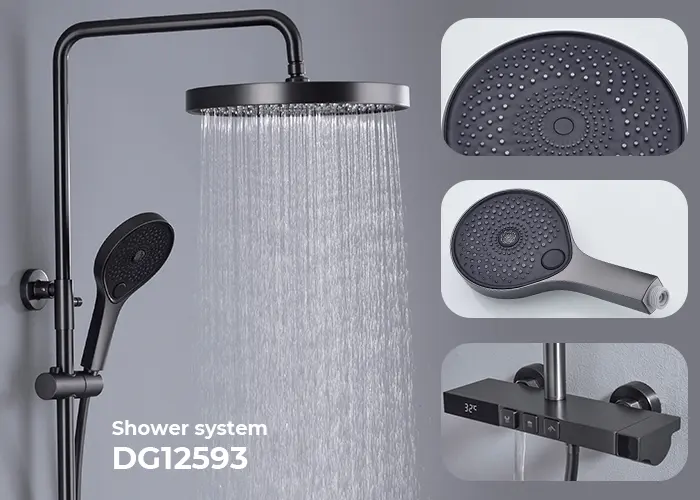
The SHOWER Act of 2026 has reignited a two-decade regulatory battle over shower head flow rates. For shower system manufacturers, faucet suppliers, and procurement professionals serving US hotel developers, construction contractors, wholesale distributors, and procurement managers, this shift creates immediate supply chain implications.
The Regulatory Shock: 2026 Changes Explained
The Safety for Homeowners and Employees Regarding (SHOWER) Act (H.R. 4593), passed by the U.S. House of Representatives on January 13, 2026, marks a significant departure from federal water conservation policies established since 1992. The legislation's core impact:
- Reverts to original EPAct 1992 definition: The bill restores the statutory definition of "showerhead" and codifies ASME A112.18.1-2024 standard, which specifies a maximum flow rate of 2.5 gallons per minute (GPM) at 80 pounds per square inch (psi) for individual showerheads
- Allows multi-head systems: The revised definition permits multiple showerheads on a single shower system without applying the 2.5 GPM cap to the combined system—a reversal of Obama and Biden-era interpretations
- State-level divergence remains active: States like California (1.8 GPM) and Colorado (2.0 GPM) maintain stricter limits than the federal standard
Important note: The SHOWER Act has passed the House but faces uncertainty in the Senate, where Democratic opposition could block or delay enactment. Final implementation details and effective dates remain pending.
This deregulation responds to mounting evidence that ultra-low-flow showerheads negatively impact guest satisfaction—particularly in luxury segments where the shower system experience defines brand perception.
Why Flow Rate Matters: The Compliance Landscape
Since the original EPA WaterSense 2.0 GPM standard took effect in 2010, hotel operators have faced a persistent trade-off between water conservation and guest experience. Understanding the current regulatory framework is essential for procurement decisions.
Flow Rate Standards Overview
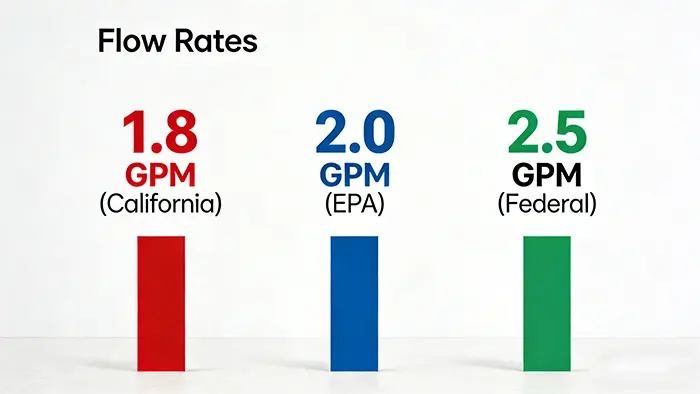
| Flow Rate | Standard Type | Current Status | Geographic Scope |
|---|---|---|---|
| 1.8 GPM | California Title 20 / EPA WaterSense | Mandated in CA (since 2018) and adopted by 14 states | State-level restrictions |
| 2.0 GPM | EPA WaterSense | Voluntary federal label; baseline in several states | National voluntary / State-specific |
| 2.5 GPM | Federal Standard (EPAct 1992) | Federal baseline; SHOWER Act aims to preserve access | Nationwide (subject to state overrides) |
Key Regulatory Milestones
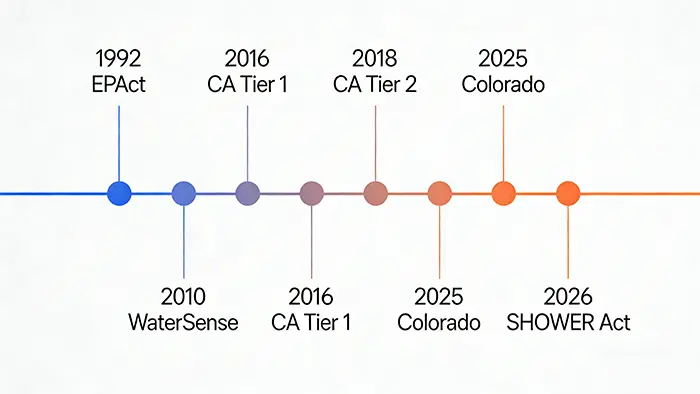
- 1992: Energy Policy Act establishes 2.5 GPM federal limit
- 2010: EPA WaterSense introduces 2.0 GPM voluntary specification
- 2016: California implements 2.0 GPM Tier 1 standard
- 2018: California strengthens to 1.8 GPM Tier 2 standard
- 2025: Colorado adopts 2.0 GPM requirement (14th state with stricter-than-federal standards)
- 2026 (January): House passes SHOWER Act; future impact uncertain
The Guest Experience Impact
According to EPA data, showering accounts for nearly 17% of residential indoor water use—approximately 40 gallons per day for the average household. For hotels, this translates to significant operational costs and guest satisfaction implications.
TrustYou's 2025 hotel rating analysis reveals that bathroom-related complaints decrease overall hotel scores by over 5 percentage points—more than any other facility category. While specific shower performance data varies by property, the correlation between bathroom quality (including shower sets, shower mixers, and basin faucets) and guest ratings is well-documented across hospitality research.
Hotels receiving poor reviews related to bathroom facilities face measurable booking impacts. Studies of review platforms show that properties with predominantly negative ratings see direct declines in occupancy rates, while even marginal rating improvements can increase revenue by 5-9%.
Strategic Implications for Hotel Developers and Purchasers
Immediate Procurement Considerations
For US hotel renovation projects and new builds opening 2026-2027:
- Market-by-market compliance mapping: Procurement teams must verify each property's state and municipal code requirements. With 14 states maintaining stricter-than-federal standards, a national chain requires multiple shower system specifications to maintain compliance diversity.
- Retrofit opportunities: Hotels in deregulated states may have flexibility to upgrade from 1.8 GPM to 2.5+ GPM shower systems without federal violation—potentially offering a competitive differentiator in guest experience. However, state-level restrictions must still be verified.
- Water utility rebates: Many municipalities offer financial incentives for WaterSense-certified products. According to EPA data, the average household could save more than 2,700 gallons annually by installing WaterSense-labeled showerheads, with corresponding utility cost reductions. Hotels should calculate property-specific rebate economics.
- SHOWER Act uncertainty: Until the bill clears the Senate and receives presidential approval, procurement decisions should account for regulatory ambiguity. Conservative compliance planning is advisable.
The ROI Consideration
While precise ROI varies significantly by market segment, property type, and local water rates, hotels in deregulated states can leverage superior shower system experiences as competitive differentiators—particularly in premium segments where bathroom amenities (including basin faucets, kitchen faucets, and bathtub faucets) directly impact booking decisions.
Key factors influencing the business case:
- Guest segmentation: Luxury and business-travel properties prioritize shower system experience more than economy segments
- Competitive positioning: In markets with abundant hotel supply, facility quality becomes a key differentiator
- Water rate volatility: Geographic water cost differences dramatically affect the cost-benefit calculation
- Rebate availability: Local utility incentives can offset upfront investment costs
Strategic recommendation: Conduct property-specific cost-benefit analysis considering local water rates, rebate programs, competitive positioning, and guest demographics before upgrading shower systems.
Technical Nuance: GPM vs. True Shower Experience
A common misunderstanding in procurement: higher GPM doesn't automatically equal better shower quality.
Three critical factors beyond flow rate determine actual user experience:
- Orifice design and spray pattern: Advanced spray plate engineering creates focused water streams that feel powerful even at moderate flow rates. Poorly designed high-flow shower systems waste water without delivering satisfying pressure. EPA's WaterSense program specifically evaluates spray coverage and spray force through consumer testing to ensure performance at lower flow rates.
- Thermal consistency: High-performance shower systems require better mixing valves (shower mixers) to maintain consistent temperature as flow rates increase. WaterSense specification requires that showerheads be marked with minimum flow rates at 45 psi to ensure compatibility with mixing valves and prevent temperature fluctuations—a critical safety consideration.
- Noise and vibration: 3.5+ GPM shower systems generate significant water turbulence. Without proper acoustic dampening, "power" showers become "noisy" showers—another source of guest complaints that independent testing protocols aim to identify.
Procurement note: When evaluating 2.5+ GPM options, request testing data on spray coverage angle, thermal stability, and noise levels. EPA's WaterSense specification (Version 1.1, updated July 2018) establishes performance criteria for these attributes at 2.0 GPM, providing a baseline for evaluating higher-flow products.
AIM's Solution: Flow-Rate Flexible Manufacturing for Shower System Suppliers

As a leading Chinese shower system manufacturer and faucet supplier serving US hotel brands, wholesale distributors, and procurement managers, AIM offers a strategic advantage in this fragmented regulatory environment.
Unified platform design for shower sets and shower mixers: AIM's modular architecture supports production across multiple flow rate variants (1.8 GPM, 2.5 GPM, and 3.5+ GPM) for our complete shower system product line—including shower heads, shower mixers, and shower sets. This approach enables:
- Reduced inventory complexity: Wholesale distributors can stock one core platform and adjust flow restrictors to match regional compliance requirements
- Faster compliance adaptation: As state regulations evolve, inventory can be converted with simple component swaps rather than full product replacement
- Cost efficiency: Bulk pricing advantages apply across all flow rate variants within the same shower system family
Beyond shower systems—comprehensive product portfolio: As a full-service faucet manufacturer, AIM also supplies:
- Basin faucets for hotel bathroom renovations
- Kitchen faucets for hospitality and commercial applications
- Bathtub faucets for premium hotel properties
Certification portfolio: AIM maintains compliance documentation aligned with North American regulatory requirements across our complete faucet and shower system product lines:
- EPA WaterSense: Certification available for 2.0 GPM and lower flow rate products
- CSA B125.1/ASME A112.18.1: Compliance with the joint US-Canada plumbing supply fittings standard (current edition: 2024)
- California Energy Commission Title 20: Registration capability for products meeting the state's 1.8 GPM requirement
- State-specific certifications: Documentation supporting compliance with Colorado (2.0 GPM) and other states with stricter-than-federal standards
Quality assurance: AIM implements testing protocols aligned with DOE, CEC, and EPA requirements, ensuring consistent flow rate performance across production batches. Detailed test reports and certification documentation are available for procurement due diligence.
Strategic Recommendations for Decision Makers
For Hotel Developers and Operators
- Audit current compliance status: Identify which properties operate in states with stricter-than-federal standards and which may benefit from potential deregulation
- Calculate ROI by location: Water rates, rebate programs, and competitive dynamics vary significantly—run property-specific economics before upgrading shower systems
- Prioritize guest-facing properties: Focus upgrades on premium and business-travel focused properties where shower system experience most directly impacts booking decisions
- Monitor SHOWER Act developments: The legislative future remains uncertain; maintain flexibility to adapt procurement strategies as regulations clarify
For Distributors and Procurement Firms
- Develop multi-tier product strategy: Offer compliance-specific packages for restricted states (California, Colorado, etc.) versus deregulated states with potential SHOWER Act benefits
- Add value through consultation: Help clients navigate the complex state-by-state compliance landscape rather than simply selling shower sets and faucets
- Leverage certification documentation: Use comprehensive certification portfolios to reassure risk-averse buyers in regulated markets
For Global Manufacturers
- Flexible manufacturing is non-negotiable: Single-flow-rate production lines become liabilities in this fragmented regulatory environment
- Invest in compliance intelligence: Maintain real-time tracking of state-level water policy changes and anticipate future regulatory shifts
- B2B education matters: End buyers need more than technical specifications—they need regulatory and business intelligence to make informed procurement decisions for shower systems and faucets
The Regulatory Landscape: What to Expect
The SHOWER Act's impact will unfold in phases, though timing remains uncertain pending Senate action:
Near-term (2026)
- Senate deliberation and potential vote on H.R.4593
- DOE guidance clarifying implementation details (if enacted)
- Procurement teams continue state compliance audits as 14 states maintain stricter standards
Mid-term (2027-2028)
- If enacted: First wave of high-flow installations in states without strict state-level restrictions; initial guest satisfaction data collected
- Competitive dynamics may emerge as hotels in deregulated states leverage shower system experience as a differentiator
Long-term trend: Industry experts predict patchwork compliance will persist regardless of federal action. Even as the SHOWER Act potentially relaxes federal constraints, progressive states with water conservation mandates are likely to maintain aggressive efficiency targets. This requires manufacturers and distributors to serve both markets simultaneously.
California trajectory: The state's 1.8 GPM standard, effective since 2018, reflects aggressive conservation goals amid chronic drought conditions. No indications suggest California will reverse this trajectory even if federal standards loosen.
Conclusion: Opportunity Beyond Regulation
The SHOWER Act represents more than a regulatory shift—it's a market opportunity. For shower system manufacturers, faucet suppliers, wholesale distributors, and procurement managers willing to invest strategically in guest experience, this evolving regulatory landscape creates measurable competitive advantages.
However, the path forward requires nuanced understanding:
- Federal relaxation does not equal state deregulation: California, Colorado, and 12 other states maintain strict flow rate limits regardless of SHOWER Act status
- Guest experience matters, but ROI varies: The business case for higher-flow shower systems depends on property segment, local water costs, and competitive positioning
- Regulatory uncertainty persists: Until the SHOWER Act clears the Senate and receives presidential approval, procurement decisions must account for potential policy reversals
The question for procurement professionals is no longer "Can we install high-flow shower heads?" but rather "Should we, and where does the business case justify investment given the fragmented regulatory landscape?"
Contact AIM Today to discuss your regional compliance requirements and explore flow-rate-flexible shower system solutions, basin faucets, kitchen faucets, and bathtub faucets for your specific market segment.
This analysis reflects regulatory conditions as of January 2026. State-level policies continue to evolve; consult local authorities and legal counsel for current compliance requirements.