January 31, 2026
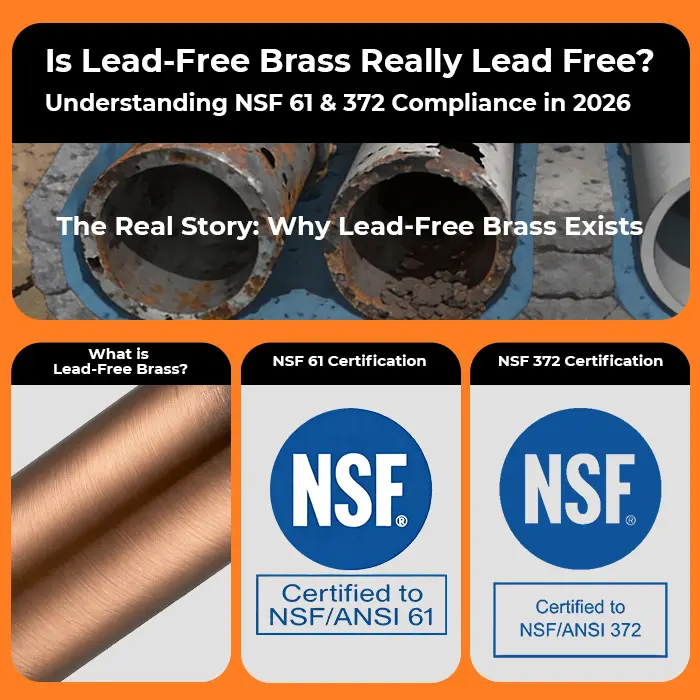
With over 6 million lead service lines still operating across North America and countless aging pipes throughout Europe, the question "Is lead-free brass really lead-free?" has become critical for manufacturers, contractors, and consumers navigating plumbing compliance in 2026.
This guide cuts through the confusion, explaining NSF 61 & 372 certification requirements, cUPC and WaterMark standards, and the infrastructure crisis driving unprecedented demand for certified lead-free materials.
Lead-free brass contains up to 0.25% weighted average lead content on surfaces in contact with drinking water. This is not a marketing term but a precise legal definition established by Section 1417 of the Safe Drinking Water Act and codified in NSF/ANSI/CAN 372.
The 0.25% threshold represents a science-based compromise. Research shows this level prevents harmful lead leaching while remaining achievable for manufacturers producing complex fittings and valves.
The "weighted average" calculation means lead content is averaged across all wetted surfaces based on their surface area. Larger wetted surfaces have more influence on the final percentage than smaller ones, ensuring realistic exposure assessment.
| Standard | Lead Limit | Application |
|---|---|---|
| NSF/ANSI/CAN 372 | ≤0.25% weighted average | Material composition verification |
| NSF/ANSI/CAN 61 | ≤15 μg/L leachate | Performance testing (leaching) |
| EPA Action Level | 15 ppb in tap water | Municipal water system monitoring |
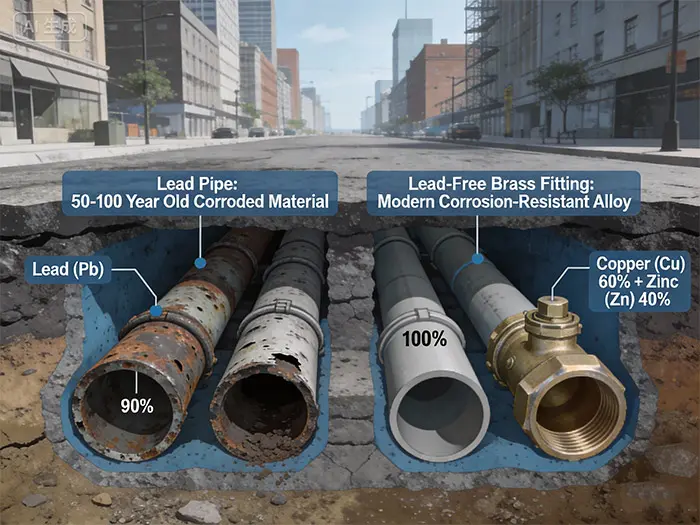
The introduction of lead-free brass materials is fundamentally a response to economic and political reality. Authorities in North America and Europe lack sufficient financial resources to replace or properly remediate decades-old underground infrastructure with complex historical ownership and jurisdictional challenges.
Beneath our cities lies a deteriorating network built 50-100+ years ago. The EPA estimates between 6-10 million lead service lines remain in use across the United States alone, with millions more aging pipes containing lead solder and brass fittings.
These aging pipe systems create hazards that extend far beyond simple corrosion:
Replacing all lead service lines would cost an estimated $50-80 billion in the US alone, according to EPA assessments and industry analysis. Current federal funding through the Bipartisan Infrastructure Law allocated only $15 billion for lead pipe replacement—leaving a massive $35-65 billion shortfall.
European estimates run even higher due to:
Rather than wait decades for complete infrastructure replacement, governments chose a pragmatic alternative: mandate that downstream components—faucets, valves, fixtures—use certified lead-free materials to provide a final barrier against contamination.
This regulatory approach offers immediate public health protection while long-term infrastructure replacement continues at the pace available funding allows.
Just as with lead paint remediation, when governments cannot eliminate the source hazard immediately, citizens take personal protective measures. The surge in lead-free brass and stainless steel fixtures represents homeowners investing in water safety that aging public infrastructure cannot fully guarantee during the multi-decade replacement timeline.
Demand for certified lead-free brass has grown exponentially since the 2014 federal lead-free mandate took effect. This reflects three converging forces: regulatory requirements, high-profile water crises (Flint, Newark, Washington DC schools), and consumer awareness that infrastructure replacement will take 30-50 years to complete.
NSF 61 certifies that products don't leach contaminants into drinking water. Testing involves exposing products to water under controlled conditions, then measuring extracted substances against health-based limits.
This is a performance standard—it doesn't care what materials you use, only that nothing harmful enters the water supply.
NSF 372 verifies the weighted average lead content doesn't exceed 0.25% on wetted surfaces. This is a material composition standard verified through XRF screening and ICP-MS testing.
Products must pass both NSF 61 and NSF 372 to be considered compliant for drinking water applications in North America.
cUPC certification from IAPMO indicates compliance with both U.S. and Canadian plumbing codes. The "c" prefix denotes Canadian recognition, enabling manufacturers to access both markets with a single certification process.
cUPC certification requires NSF 61 and NSF 372 compliance as foundational requirements, plus additional performance testing.
WaterMark is mandatory for plumbing products in Australia and New Zealand. Administered by the Australian Building Codes Board (ABCB), it covers drinking water safety through chemical testing, performance verification, and ongoing factory audits.
WaterMark requires compliance with AS/NZS 4020 (chemical safety) and product-specific performance standards.
Both materials offer lead-free compliance, but each serves different applications.
Lead-free brass delivers optimal cost-performance balance for residential and commercial plumbing. Advantages include:
Stainless steel provides superior strength and extreme environment performance but costs significantly more. Choose stainless for:
For typical faucets, shower mixers, and valves, lead-free brass offers the best value while meeting all safety requirements.
Lead-free brass certification requires rigorous multi-stage testing:
Certification bodies conduct unannounced factory inspections and market surveillance testing to ensure ongoing compliance.
No, lead-free brass contains up to 0.25% weighted average lead content. This legal threshold, established by the Safe Drinking Water Act, prevents harmful leaching while remaining manufacturable. The 0.25% limit is based on extensive toxicological research showing this level poses negligible health risk.
Aging infrastructure that governments cannot afford to replace immediately forces downstream protection. With 6-10 million lead service lines still in use and full remediation costs estimated at $50-80 billion in the US alone (against only $15 billion in federal funding), authorities mandate lead-free fixtures as a practical barrier protecting drinking water during the multi-decade replacement timeline. Consumers increasingly choose certified products for immediate protection.
NSF 61 tests what leaches into water; NSF 372 verifies material composition. NSF 61 measures actual contamination through leaching tests, while NSF 372 confirms lead content doesn't exceed 0.25% on wetted surfaces through material analysis. Both certifications are required for full compliance.
Yes, for plumbing products sold in Australia and New Zealand. WaterMark certification is legally required for any product contacting potable water in these markets. It covers health effects testing per AS/NZS 4020, performance standards, and ongoing quality verification.
Lead-free brass suits most residential and commercial plumbing applications. For extreme conditions—highly corrosive water, extreme temperatures, very high pressure—stainless steel may be necessary. For typical faucets, valves, and fixtures, lead-free brass delivers optimal cost-performance balance while meeting all safety standards.
Lead-free brass isn't marketing hype—it's a regulated, science-based standard anchored in NSF 61 & 372, cUPC, and WaterMark frameworks. While not absolutely zero-lead, compliant alloys meet strict 0.25% limits proven to protect public health.
The rapid growth in certified lead-free products since the 2014 federal mandate reflects practical reality: with $50-80 billion needed for complete lead pipe replacement but only $15 billion currently funded, achieving safe drinking water requires multi-layered protection. Aging infrastructure takes decades to replace—certified downstream fixtures provide immediate safety.
For manufacturers, achieving NSF 61 & 372, cUPC, and WaterMark certification is now essential for market access in North America and Oceania. For consumers and specifiers, choosing certified lead-free products ensures compliance and public health protection during the extended infrastructure modernization timeline.
Key takeaways for 2026: Lead-free brass delivers corrosion resistance, pressure performance, cost-effectiveness, and regulatory compliance while serving as an effective barrier against contamination during the multi-decade process of replacing aging water infrastructure systems.
NEXT: H59 Brass vs 304 Stainless Steel Faucets
PREV: End

AIM Faucet is not just a faucet manufacturer or wholesaler, but more like a partner who can provide you with more added value.
We are united in our determination to produce China-made bath and kitchen fixtures adhering to the highest ethical principles. You have our promise!